
The Bill Evans Interview - Ted O'Reilly - February 1985 CODA

© Introduction Copyright ® Steven A. Cerra, copyright protected; all rights reserved.
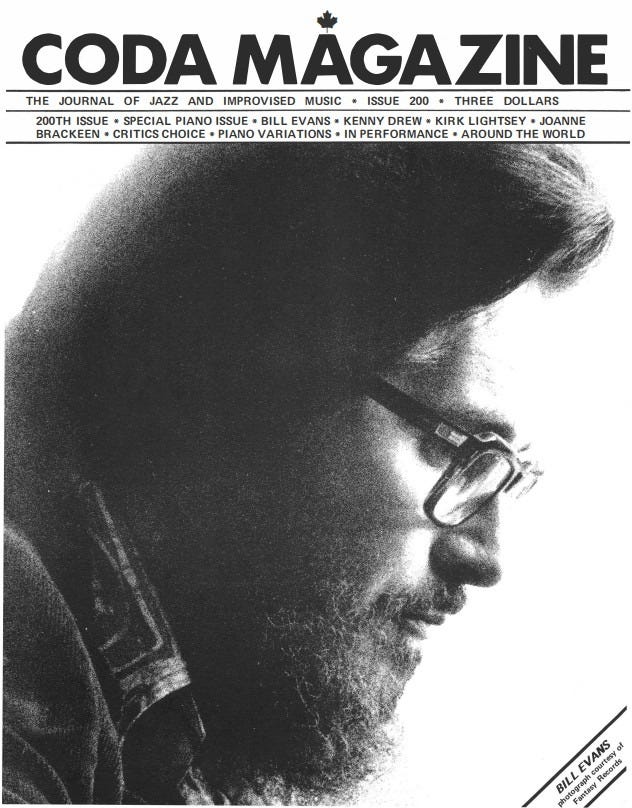
I am in the process of expanding and revising my Bill Evans Reader and I hope to have this new edition ready by the end of 2026. Among the many “new finds” that I plan to include in the enlarged edition is this piece by Ted O’Reilly which was published in the February 1985 edition of CODA, a Canadian Jazz magazine that ceased publication in 2009.
I thought I’d share this treat with all of you now as a sort of early holiday gift.
The following interview took place on July 9, 1980; Bill died on September 15, 1980.
© Copyright ® Ted O’Reilly, copyright protected, all rights reserved. The author claims no right of copyright usage.
“I was as shocked as anyone when Bill Evans died on September 15, 1980. He was only 51 years old - too young for anyone, but especially for a musician who, it seemed, was entering what might have been his most important phase. And that from a man who had already done as much as any other pianist to influence the course of jazz. I’ve been doing a jazz radio show in Toronto since early 1965 on an educational radio station, one which allows me complete freedom in choice of music and interviews. I talk with whom I want, and for the length I wish. Of the many hundreds I’ve done, some naturally stand out: a couple with Charles Mingus, Eubie Blake, Mary Lou Williams, the straight-on honesty of Art Pepper, and maybe most of all, Bill Evans. He was a relatively frequent visitor to Toronto, and when I would learn he was coming, I’d start anticipating both his performances and the talk we would have, since they were so much alike - intelligent, thoughtful, and quietly passionate. I never came away from an interview with him without feeling I had learned something, or that he’d made me think about the music, and the investment he (and others) made in the art. With music, this particular talk went on for an hour and a half, almost, and though we had talked often before, and the talks were always increasingly illuminating, this one was the best. Maybe he was trusting me more, or with some sort of prescience felt he wanted to explain what he was doing, or this then trio (with Marc Johnson and Joe LaBarbera) was exciting him anew. I don’t know, but it is an important chapter in The Educating Of Ted O’Reilly. I know Bill enjoyed it: it was done on a Wednesday afternoon for broadcast at about 10:30 that night. When I dropped into the club that night it was between sets, and Bill was in the dressing room with Marc and Joe, listening to himself talk, with the same intensity he might listen to a tape of his playing: analysing, commenting on what he said, and in general approving. Joe LaBarbera later told me it was probably the last interview Bill had done, certainly the last major one. Sixty-eight days later he was dead. The following interview took place on July 9, 1980.
[Caveat: as is the case in the UK, Canada also uses English spelling.]
TED O’REILLY: I think Bill, the trio you have now is beginning to match the trio of Scott LaFaro and Paul Motian.
BILL EVANS: I’d say the same thing. It’s definitely related, like they’re joined, and while everything that happened in between has its own worth and quality, it does not have the same kind of organic feeling or the same kind of inner growth that this trio has been manifesting. So I agree with you. I must say, too, to take some of the responsibility, that at this particular period of my life I am much more ready to contribute to the kind of trio this is than I was in the years that Eddie Gomez was with me. I don’t think I was ready to be as alive and on the inside of the music as I am now. We tried to really be resourceful and in no way would I put those trios in a lower category. But I tended to stay with a similar way of doing certain things for a long time. I played Polka Dots And Moonbeams in F for years with about the same type of opening chorus with a lot of the same figures in it. When I decided to play Polka Dots with this trio I started in C and used an entirely different approach.
Without really considering it, If You Could See Me Now just automatically became a long line. In other words I played eight to a measure instead of four and two. It stretches out and hangs. That just happened. When we get to the blowing chorus we would play the regular meter. The evolution of certain songs in the repertoire that had remained rather static, where the improvisation was fresh and resourceful, had been changing. In My Romance now we trade choruses with Joe LaBarbera and he has a function of changing the tempo at the end of each of his choruses. We use a sub-division of the previous tempo which makes the next tempo a bit slower or faster. And he can choose how to do that so that each chorus is at a different tempo.
Nardis is a tune that has evolved slowly through the years. I started to play it in about 1959 when Miles wrote it for a Cannonball Adderley date which featured Blue Mitchell (trumpet) on his first recording on Riverside with Sam Jones (bass) and Philly Joe Jones (drums) and myself. I did it with my original trio and I have been playing it through the years. But it has now evolved into something which is absolutely unique in our repertoire. There is a long solo section in the front that I play, then we state the original chart, and then we do a little send off chorus. Joe plays a long solo and then we re-state the chart. We are all using the form very strictly, we’re playing within the form, we don’t vary it and it’s always there. But we have found a kind of freedom on it that, I would say, if three or four people a year know that we’re using form might be surprised because we really get off of it, rhythmically and harmonically in every way.
But I think relating to the form gives the content of what we’re doing more fibre. It would be ideal of course (and that’s where you get the total meaning of what’s happening) if the listener knew. specifically at every moment how we’re referring to this strict form but still, if he doesn’t know that, what’s coming out is being determined by that form, will have more meaning to the listener as well.
That tune is like therapy for us. We play it almost every night, we all play almost totally new solos on it. They are stylistically similar but the ideas and the development are different. I don’t know what resourcefulness Marc Johnson draws upon but he comes out with such fantastic solos on it. They’re like finished works of art. It’s almost like the greatest bass virtuoso in the world was practising a piece for two years and now decides to play it in public. Yet it is always a new solo. Every time. I almost wish, sometimes, I could line up about twenty of our performances of it and put out a four-album set. They take fifteen minutes each. Just so that the jazz I listener knows the extent of the resourcefulness of some musicians. I don’t think they fully understand the challenge: that a jazz musician is trying to work on as pure a level as he can accept.
Mostly we go in and do these recordings cold, not having really organised the material very much. Sometimes I have not even selected all the material. There’s a kind of higher level of professionalism where we throw together a routine - of keys or intervals - however we are going to approach each performance. The amazing thing is that it almost always seems that the recorded version hits the essential conception for this trio of that particular thing. If we play it for years it develops but still comes off that kind of conception. So it’s kind of interesting from that standpoint. And the freshness is good. It’s not only a challenge but it allows us to be dealing with the material very freshly. Like the track from “Affinity” with Toots Thielemans. All this music we got together in the studio. Toots brought in some things including a ballad of Paul Simon’s which he had realized the potential of. I play I Do It For Your Love all the time now, it’s really a wonderful ballad. Of course, Toots’ treatment of it modified and sophisticated Paul Simon’s original (on a musical level) and I added some more to that. I’ve heard the original, and it’s a very plain statement but the song is there. This Is All I Ask is a Gordon Jenkins standard and at one point Toots asked whether I knew it and I said, “Gee, I don’t think so.” He knew this was my kind of tune, and he brought out the sheet music. I looked at it for a minute and made some modifications.
What do you mean when you say you made some modifications?
Well, the sheet music goes like this [sings a phrase]. Now, right there, the music goes back to the key tone. You’re in F, it’s an F chord with an F in the bass, so I modified the structure. It takes a lot of experience working with popular songs and really getting into the structure on a high level of sophistication to be able to look at a piece of sheet music and know what should be changed.
You have to see the total structure and see how it should move, and in a fundamental way, not just looking for strange sounds, or substitutions, and get it to where I felt this is the way I would like to handle the structure.
So basically you’re going to change it harmonically?
It would be the basic theoretical structure of what I’m going to do. Now once Marc Johnson and I understand that, and the soloist, whoever that might be, then you work within that, moving towards these strong structural points and handling it with different sonorities and so forth. But you know what direction you are heading for and why. It’s kind of a technical thing and I’m sure it doesn’t matter, and should not matter, to the naive listener. All he wants to do is hear the music. But if you heard the sheet music and then heard the way we do it you might appreciate that this gives it some kind of a better dimension.
You were talking about the way you used to make records ...
Well, this particular day we did a complete Chet Baker LP and the rhythm section was Paul Chambers and Philly Joe Jones and myself. We started playing a little trio thing at the end, just for kicks, and Bill Grauer, who was Orrin Keepnews’ partner at Riverside, came piling out of the booth and said, “Why don’t you guys do a trio record now, while you’re here?” We looked at each other and we thought - another cheque! However, it’s a shame because that particular trio, who were with Miles Davis at that time, is not represented on record except for “Jazz At The Plaza” which we didn’t know was being recorded. It was potentially such a wonderful thing and to throw it together like we did, not getting anything together, wasn’t fair. We just went ahead and said let’s do this tune and Bam! - that was it. Now, after all these years and with Paul dead, Orrin Keepnews convinced me from the standpoint of historical interest and so forth it might justify putting it out. I feel that some of the music isn’t bad but it’s a little much doing two LPs in one day. What it could have been is what bothers me. If we had the chance to come in a little rested, and think about a concept, we might have done something which would have been a treasure to me, at this time.
Do you always try to approach recordings - and you’ve made hundreds - without too much preparation?
Generally, I approach records pretty much that way. When we made “Affinity”, the only thing I had in mind was to do some duets with Toots, perhaps one or two trio numbers, some quartet things and then to add Larry Schneider on soprano and tenor to make a quintet for a few tracks. During the course of the day we just selected things, got a little routine on them, saw how they sounded and just went ahead and did it. There is a trio record in the can at Warner’s with Eddie Gomez and Elliott Zigmund (from 1977) where we went in and did that. I found Gary’s Waltz (a.k.a. Gary’s Theme) from looking through the fake book [a music book which has the melody and chords of popular tunes and jazz standards]. We still play it and it’s a lovely thing. Sometime Ago was in the same book and Tommy Lipuma (A&R and coproducer) got a lead sheet for the Theme to M.A.S.H. which I have always liked and we threw together a routine which is fun and we still do it. There was an original of mine that I had written for my brother called We Will Meet Again. Another version of that tune was recorded later as a solo piece for the new quintet LP which is now out. We also did Jimmy Rowles’s Peacocks and that’s a tune we had never played. That’s the kind of professional challenge that jazz musicians do, and have done, most of the time when they make records.
You’ve been a professional musician for thirty years now, and are now producing music much more challenging than anything you ever did before. This is the opposite of most people who make their biggest contribution during the first decade they are performing.
I don’t know precisely the reason but I do recognise that a year or two ago was the beginning of a period I recognise as the best creative and performing period of my life. Jazz is much like professional sports - don’t look back, they’re gaining on you. There is a lot of young energy coming onto the scene all the time. Of course I had young energy when I was eighteen. I was the king of locked hands! But whether you carry that thing forward into the area of maturity, and scope of expressivity, and make a contribution to the tradition of the music that you’re working in is another question. You always hear young talents that come on the scene who you say have got it all covered already. Of whom would you say that these days? I’ll give you an example of what I mean. Herbie Hancock came on the scene when he was eighteen and was really playing it all. There’s an example, though, in a sense of a commercial corruption which the United States makes. The United States didn’t make it, Herbie made it. Now there may be a reason. He’s a great player. But with all that, having the scene covered and all, perhaps his real inner commitment to a lifetime of that particular commitment wasn’t there. Or maybe in his own mind he recognised, or chose, that he didn’t want to drive forward within that area. I don’t know why particularly. He would certainly have his reasons. That happens, and I often refer to that as something that young talents might perceive, because I used to feel discouraged. I didn’t have the kind of facility, the liquid approach, that real thing of just sounding like you’re playing. I had to put it together stone by stone. I would say I was a late “arriver.” Because I put it together stone by stone I ended up with something which I completely understood, could work with, discard, add to, extend, because I understood everything about it, right down to the bottom. But still, at certain points, you hear other musicians of your age that have this kind of fluidity. And you might feel - gee, I just don’t have that natural thing. I’ve come to appreciate what I call late “arrivers.” More than anybody, I think Miles Davis is a late “arriver.” You knew he was on the scene and everybody that could perceive talent knew from the beginning. But you can hear Miles very cautiously (on some of those first recordings) playing the flatted fifth and dissolving and developing and developing. But he wasn’t projecting that much. When he hit the scene in New York, with the quintet, in about 1956, that was a different Miles. He found it and just put it all together. And nobody’s played that kind of beauty before or since. That way, he’s a late “arriver” - somebody who digs away and develops and develops and develops and then they bust through.
Tony Bennett is somebody I appreciate that way. I couldn’t understand his thing, really, when I was young. I thought his vibrato was bad, his voice was thin, and yet Tony is the kind of person who loves and respects music on a very deep spiritual level. He just has gotten more inside himself, and more inside his art all the time, until finally he has the ability to transport the listener that’s unmatched. I think it’s a great art, in that type of singing, to take a straight song and sing it relatively straight and somehow put more meaning into it and be able to grab the listener and transport them. When I listen to Tony I don’t hear words, I don’t hear a vocalist - I just hear music. That’s why I really love his singing. I find it is a much harder journey for the later “arrivers” but what they have at the end of it is something much richer.
I don’t know how to say this without it sounding wrong in somebody’s ears, but to me jazz music has always been a black American art form, and all the creators of the music and the main influences of the music have been black save for possibly Jack Teagarden and, I’m beginning to believe that more and more now. The thing I love about jazz is that it is about the only kind of music that comes from an ethnic source at the beginning which has elevated itself to the point where it crosses all those borders and barriers. Gospel and R&B stay black, they really do. Maybe rock and roll is a form of white R&B, who knows. What I’m saying is that jazz has that honest artistic conscience where all the way through white men have played with black men, played jazz on a level where the black man has said - yes, you’re playing jazz, play with me. And that was the response. No kind of prejudicial, racial thing on either side and it’s been proven time and time again. I think it’s an old and tired subject because now jazz has drawn on so many elements of the white culture and so it’s a mutual thing - way above all that. Now it’s an art that one must recognise the roots, and try to stay true to the roots but to me it’s the one music that crosses those barriers with complete honesty, without any commercial considerations, or racial considerations, or anything. If you can play it, it doesn’t matter.
Let’s face it, the black community doesn’t know about jazz. They really don’t. They never did - there was only an inner group. The black musician would be the first one to agree to that. Our people don’t know much about jazz either. Someone like Miles will talk as if he’s a bigot, yet at the time when black pride was running high and he had perhaps the greatest jazz band ever, the first change he made in that quintet was to call a white man, myself, to play in the band. I didn’t know Miles. I didn’t suck up and say, “If I get close to Miles I may get a gig some day.” I was shocked to hear him on the phone one day asking me to play a weekend and, subsequently, to join the band. So it’s that kind of thing, no matter how he professes to appear, philosophically and socially, on the musical level it’s honest.
It’s a tired argument, it really is. I hope it fizzes out pretty soon because it’s just human beings and love. You don’t have to be born in a log cabin in Mississippi to play jazz. You just have to love it - that’s all. And live it. You have to hear it first of all. That’s a great problem. That’s why when people really get hung up on trying to justify the high artistic significance of the Beatles, or something, I feel like puking. Because it’s a commercial mass media product. That’s the primary goal and I think quality, real quality - which is classical music and jazz to me - is not going to sell double platinum. It just ain’t going to happen. If it does then it’s no longer part of that stream, because in order for it to qualify it’s not going to get to people who want to be challenged. So that’s the way I see it and I’m not sorry about it because I think it protects the music in a way. And the real genuine honest committed talents are attracted to jazz.
The sixties were a tough decade for jazz. Still, new jazz talents arrived into jazz because that was their spiritual and musical commitment. It was very hard for a young jazz talent in that decade to find a way to get established, but they were not going out and giving up jazz and changing their style. It was just tough. I’m very thankful because my position now is like heaven. It’s what you pay all your dues for. I have a marvellous trio with Marc Johnson and Joe LaBarbera and we’re playing the music we want to play and under good conditions. We’re getting appreciation and respect, and we’re making a decent living. However, you can almost count on both hands those who are in that position. There are so many good players everywhere who are forced to play, most of the time, below their abilities. The general jazz public somehow still has that thing of wanting to hear the big timers from New York. I would emphasize that there are many high level local musicians all over the world who deserve to be able to play at the highest level and be appreciated. So try to support those people. If there is a little club that presents them, go out and hear them, because you are never going to hear on record what you may hear live. Our best performances have gone into the atmosphere, and we never have gotten on record that special peak that happens fairly often. You never know. And there’s just something about that physical contact anyhow. There’s nothing like it. I know what it takes to learn to play and guys that play as well as they do deserve to be practising their art and to be appreciated. For the most part they are not able to do it. They are mostly doing studio work or gotta play a gig where they’re not allowed to get off the melody. It’s too bad. I would say that to the jazz audience. Keep that in mind.
You are not noted as a blues player but Loose Blues is an exception. It’s with Jim Hall, Philly Joe Jones ... My all time favourite drummer. Zoot Sims and Ron Carter.
This was from an all-original-music record. Again, the amount of money available at Riverside at that time almost prohibited limitless time to accomplish a record. I went in with original music which had some very difficult stuff. One tune was called Fun Ride, which I can hardly play, there was a jazz fugue, I think, we did Time Remembered and this Loose Blues. I had about four or five different sets of new blues changes which I had written out for the guys if they wanted to choose a new set. And Ron Carter was the only one that accepted the challenge. He had that kind of interest. Jim Hall may have also. I can’t remember. I couldn’t get a complete take on everything so there was going to be some editing. I went in and started to edit and I just put Loose Blues together. When I came back to do the next editing session, I found out that the tape had run off into a barrel or something, and then the trash man came ... So this is the only thing left from that date. I like this little blues line. It’s a minor blues that’s kind of cute rhythmically and in the way the intervals move.
From talking with you about the problems of recording companies you obviously try to maintain as much control of what goes out as is possible.
Now, we have an approval clause. But take the “Jazz At The Plaza” date with Miles. None of us had any idea that it was being recorded and of course the sound quality is not, certainly, high level. It’s the only thing with me and Philly Joe Jones. We had started to get a particular thing going with Paul Chambers and Philly and me as the rhythm section. I have some tapes from the Cafe Bohemia by the band where I play differently than at any other time. You can hear the lay-back feel, and all that I didn’t get with Jimmy Cobb because he’s a different kind of drummer. So it’s interesting from that standpoint. Another example was a recording for Verve with Stan Getz and me; a record where he had contractual approval. They put the record out and he could have sued but you end up maybe getting very little satisfaction. And that Plaza date for instance. They wanted to pay us, who were still alive, 1958 scale when the record was released. I got a little more but even so they really had no right to record and they had no right to put the record out. Now there’s this “Live At The Trident” date. I have contractual approval with Verve. I did the “Live At The Trident” things with a trio that I thought was far below what I wanted to have released. That’s one of the few occasions where I haven’t released a record. But the next thing I know, it’s out. Slapped out with a cover that nobody cared about. About a year later Leonard Feather called me. He said, “I want to talk to you about a “Live At The Trident” album. I’m going to do the notes.” Well, I said that album’s been out. He said, “No, there’s going to be a second one from those tapes.” I said, “Oh man. Hold it.” It was just a fortunate thing that he called me because they would have had it out there before I could do anything about it. As it was, I found out in time to bring it to a halt. They do those things. It’s just like royalties. Most of them figure, “Let’s not pay royalties. Now, if they (the musicians) come after us we’ll make a settlement and we’ll come out far ahead.” That’s the way a lot of smaller companies operated and even some of the big ones. But jazz needs those companies because until you establish yourself those companies offer an entranceway. All I knew I wanted was to record, get some records out there. To sign a standard union contract with Riverside for two records was to me the biggest thrill that could happen. And at that time Riverside was just a converted grocery store. You forced your way through and around some cartons and stuff and you found Bill Grauer and Orrin Keepnews. I had been referred to them by Mundell Lowe and Trigger Alpert because I had played a gig with them which Trigger had taped on a portable Ampex. They got excited and gave me the contract. But you wouldn’t get that chance from RCA or CBS. So those companies do serve a function. I never saw a royalty statement and never expected to get one. I didn’t care really because at that point you just want to get your records out there. That’s how it works - for both.
Do you find it easy to live on the road?
I pamper myself a little bit as far as hotels because your morale is important. I will try to stay in Class A hotels where you have room service at least. Not a depressing room or hotel. So that way I don’t mind that much. You miss the things that are close and familiar at home, but on the other hand you do get away from the pressures that surround you at home like the phone ringing. It’s refreshing to be in new environments. Like the European tour we did last November (1979): 21 cities in 24 days. It was hectic and backbreaking. We really got unreal about the standards we were imposing upon ourselves as far as performance, and we really felt we had not performed well. When we finally got off the tour and heard tapes of many of the concerts we wondered what the hell was going on with our standards, for we had made a lot of progress. Some of the performances we had felt weren’t satisfactory I would make a record of, they really were at a high level. You can draw on yourself very deeply in your music, an inner calm that you have. And a perfect example of it is Peace Piece, which is fairly old and has long been one of my favourites. The man [Leonard Feather] who wrote an article on me in Contemporary Keyboard recently did an exact transcription of Peace Piece. I read it through and it’s absolutely correct. If some people wanted to get a written copy of this, this is the first one that has ever been available as far as I know .
Peace Piece is actually an extension of an introduction to another song which shows Bill Evans as much as a composer as anything. Do you consider yourself as more of a composer than a performer?
No, I don’t, because I don’t function regularly as a composer. A composer should be composing every day. I went through a great conflict at one point in my life as to which road to follow. I still intend to do some serious writing and I consider myself a composer - but not full time. Certainly not more than a player. I consider writing as something which I’m just doing now for the most part within the idiom that I use. But when I was going through this conflict in New York and majoring in composition the pieces I wrote were in a variety of styles, very unlike the idiom that I play in. You can sit down and dig away, and sort out, and handle areas of music that, in composition, you can’t handle in a spontaneous way. To handle music in a spontaneous way, you have to have quite a mastery in the area in which you are trying to be spontaneous. Some of those pieces I wrote are kind of interesting; like, for instance, one is a four voice canon on a twelve tone ostinato. It’s intense and frantic and so different that you would never relate it to me if you knew my performing identity. I think, now, I’m just going to be writing more but what it becomes, or what area of music it reflects, is another question. But I have written quite a few things in the last year, things that are on the latest release: Laurie, a ballad; Bill’s Hit Tune - just a hopeful title [smile], but if it’s played slow it has a quality of a French movie theme but the form and progressions are very nice for blowing. I wrote a tune for my son called Letter To Evan, which I like very much. We did a live album at the Village Vanguard three weeks ago and I included four new originals. One is named after Joe LaBarbera’s baby daughter and is called Tiffany. It’s a nice melodic little waltz. There is one called Your Story which is kind of unusual. It has only one idea in it. It’s a repetitive idea about the harmony and the form, moving in such a way that it gives a different meaning to that idea, as it appears each time. There’s another one called Knit For Mary F which is based on two ideas: a repeated note idea and a three note motif. Then there’s Yet Nere Broken that’s a medium bright tune which just moves in a little different way.
I think you’re someone who performs so beautifully, that a live performance of yours is, to me, the essence of jazz. There’s no messing around.
You hit those peaks so often and you say, “Why couldn’t we have gotten that one.” As it worked out we recorded four nights out of the two weeks at the Village Vanguard. Wednesday and Thursday of the second week were going to be it and then we scheduled Sunday as a safety. Well, the first night was practically meaningless as we were getting sound together and we just didn’t seem to be getting there at all. However, there were things that were better than I thought when I went back and listened to the tape. But the next night was appreciably better and by the last set we were beginning to get there. As it turns out I think I used a couple of things from that last set on Thursday night. By now I saw that this was on the upgrade and I knew that Friday and Saturday were probably going to be the peak. So I said to Helen Keane why don’t we schedule this for the rest of the week. She was a little bit hesitant because it’s quite expensive so I said let’s do tomorrow night anyhow and then Sunday. So Friday night was quite a good night, throughout. It was decent but sure enough, Saturday was the night! That was the one we didn’t record. Always the peak night. But we got some good stuff and have enough material for two albums plus twelve to fifteen minutes, so we can discard one or two tunes that we feel are the weakest. I don’t know whether they are going to accept the idea of two albums but there’s material I hate to give up.”
Lovely piece. I agree with him about Herbie.